
Written in November 2025
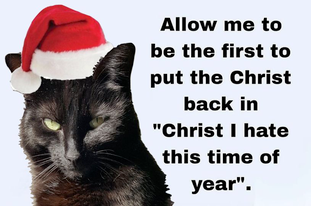
That’s my friend’s scowling cat, and her face sums up how I often feel about Christmas.
I don’t actually hate Christmas, not all of it anyway. I love cutting a holly tree and decorating it, I love the nostalgia of putting up decorations that remind me of my grandparents, I really love sampling my fruit-infused gins and brandies, in the name of quality control, of course.
The familiar Christmas movies, TV specials and (some of) the music is so comforting to my autistic need for familiarity and predictability, while the act of Christmas shopping – which I do almost entirely online in spurts from October – satisfies the ADHD need for novelty and curiosity.
So what’s difficult about Christmas?
For me, it’s the people and the socialising and the presents. There is a lot of pressure to go to social events and to meet up with people you only see once a year and while I really enjoy those one-to-one meet ups, they often happen in busy places. My Loop earplugs will be a real help (if I remember to actually wear them) in these situations.
People in the house is also something I struggle with. I have a 2 day/night limit on guests regardless of how much I like a person – it really is nothing personal, I just need my space to be safe and as empty as possible! I can’t recover from the demands of social contact without that safe quiet space, so the thought of not having access to that is a significant source of anxiety that runs from mid October all the way through to mid January (yes, it takes my system that long to regulate).
This might look like overthinking from the outside, but it’s not. This thought process is the autistic pursuit of self-preservation and regulation. We need to think about every aspect of events, situations and potential scenarios to weigh up whether we can partake or not. The times when I haven’t “overthought” something are the times I bail out at the last minute, or leave suddenly as soon as I get there, or have a shutdown/meltdown. “Overthinking” allows me to avoid this and make better decisions.
Presents can also be hard. I remember being told off as a child for not looking happy enough or saying thank you in the right way, so the act of exchanging presents can be quite a chore with the need to perform in the right way. I’ve had a few decades of practice now, so I can manage this for one day, but it does add to the nervous system burden. If I use Fork Theory to describe this, it used to be a pitchfork but it’s now more of a salad fork.
My next blog will be all tips for doing a neurodivergent friendly Christmas, so stay tuned!